中文
中文
 English

Japanese MIC Terminal Device Certification
- Overview
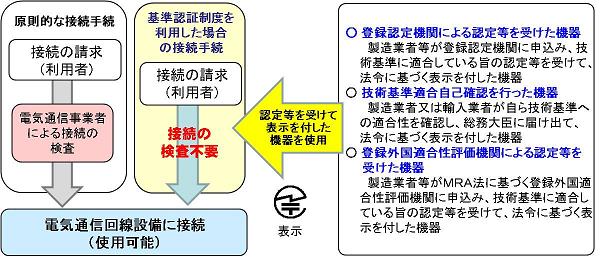
When connecting terminal devices such as telephones, fax machines, or modems to the telecommunications operator's network (telecommunications line equipment) and using them, the user's telecommunications operator connection should be checked in principle, and the terminal device must be confirmed to comply with technical standards based on telecommunications commercial law.
However, if a device with instructions (technical applicability marks) specified by the regulations of the Ministry of Internal Affairs and Communications is obtained, such as a certificate of compliance with technical standards from a registration and accreditation agency, the user of the terminal should be able to connect and use the device without the need for connection checks by the telecommunications operator (see figure below). (Article 69 of the Telecommunications Commercial Law)
*Technical standards are defined in accordance with Article 52 (2) of the Telecommunications Commercial Law in the 'Terminal Equipment Regulations' to ensure the following matters.
(I) Do not damage telecommunications line facilities or impair their functionality.
(II) Please do not disturb other users using telecommunications line facilities.
(III) Ensure clear division of responsibilities between the telecommunications line equipment installed by telecommunications operators and the terminal equipment connected to users.
2. Standard Certification System of Telecommunications Business Law
(1) Certificate of Compliance with Technical Standards (Article 53 of the Telecommunications Commercial Law)
For the certification of technical standard consistency, personnel registered by the Minister of Internal Affairs and Communications (registration certification bodies) determine whether each terminal device complies with technical standards based on the telecommunications business law of each terminal device. This is a system.
According to the regulations of the Ministry of Internal Affairs and Communications, registration and authentication institutions will authenticate each terminal device after inspection.
The technical applicability mark is affixed to terminal devices that have been certified by a registered certification body.
Anyone can apply for technical standard compliance certification from a registered certification body.
(2) Design certification (Article 56 of the Telecommunications Business Law)
Design certification refers to the quality control methods (confirmation methods) used in the design and manufacturing stages to determine whether terminal equipment meets technical standards, and whether registration and certification agencies determine suitability. This is an authentication system.
Because it is designed for terminal devices rather than the terminal devices themselves, the actual terminal devices are manufactured after authentication.
After the person who has obtained design certification (certified distributor) fulfills the design qualification obligation stipulated in the Telecommunications Business Law, a technical applicability mark will be affixed to the manufactured terminal equipment.
The contractor responsible for manufacturing, selling, importing, repairing, inspecting, and processing terminal devices can submit a design certification application to a registered accreditation agency.
(3) Self confirmation of technical standards (Article 63 of the Telecommunications Business Law)
The self confirmation of technical standard compliance refers to the manufacturer or importer of terminal equipment (special terminal equipment) designated according to the regulations of the Ministry of Internal Affairs and Communications, which is unlikely to seriously interfere with the communication of other users. It is necessary to confirm that the equipment design complies with the technical standards based on the Telecommunications Business Law and ensure that any specific terminal equipment based on this design complies with the design. This is a system that can only be executed when it is considered possible.
After confirming and submitting a notification to the Minister of Internal Affairs and Communications that the manufacturer or importer (reporter) has fulfilled the design qualification obligations stipulated in the Telecommunications Business Law, a technical applicability mark will be affixed to the manufactured terminal equipment. This will be.
Only manufacturers or importers of specific terminal devices may perform self confirmation of technical standard compliance.
3. Standard Certification System Based on MRA (Mutual Recognition Agreement)
MRA is a bilateral agreement that allows the country to conduct equipment certification (inspection/confirmation of equipment compliance with technical requirements) in its own country/region. The purpose of MRA is to promote the export and import of telecommunications equipment and electrical supplies overseas, alleviate the burden on companies, and facilitate bilateral trade.
So far, MRA agreements have been reached with the European Community (EC) (effective January 2002), Singapore (effective November 2002), and the United States (effective January 2008). It is.
According to MRA regulations, foreign registered qualification assessment agencies designated and registered by foreign designated institutions can provide technical standard qualification certificates and design certifications to Japan. For detailed information, please refer to http://www.tele.soumu.go.jp/j/sys/equ/mra/index.htm 。)
。)
4. Target terminal device
- (1) Analog telephone equipment (telephone equipment (telecommunications line equipment used for telecommunications services, mainly for telecommunications services aimed at voice transmission and exchange). In the connection with terminal devices or self operated telecommunications equipment, analog signal input and output) or mobile telephone devices (telephone devices connected to terminal devices or private telecommunications equipment), telephones, private branch exchange facilities, key telephones, modems, fax machines, and other terminal devices and communications notified separately by the Minister of the Interior (excluding the contents listed in (3))
- (2) Internet Protocol telephone equipment (telephone equipment (telephone number rules (Ministry of the Interior Communication Regulations, Law No. 4)) refers to telephones, connected private branch exchanges, key telephone equipment, code conversion equipment (Internet Protocol) terminal equipment or dedicated telecommunications equipment), and terminal equipment that performs call control for fax and other calls.
- (3) Internet protocol mobile phone equipment (mobile phone equipment (limited to the equipment providing voice transmission services by using voice transmission mobile phone numbers listed in Schedule 4 of the Rules for Telecommunication Numbers)). Terminal devices that use Internet Protocol to connect to terminal devices or self operated telecommunications equipment
- (4) Radio paging equipment (telecommunications line equipment used for telecommunications services, intended for telecommunications services intended to call users (including accompanying reports) by radio) connected to terminal devices
- (5) Integrated digital communication equipment (telecommunications line equipment used for telecommunications services, mainly integrating code, voice, and other sound or image at a digital signal transmission rate of 64 kbps). Terminal devices connected to telecommunications services for this purpose are used for transmission and exchange
- (6) Specialized communication line equipment (telecommunications line equipment used for telecommunications services, allowing specific users to use the equipment for telecommunications services) or terminal equipment used for digital data transmission connected to the equipment (telecommunications line equipment used for telecommunications services, only for telecommunications services, used for exchanging codes or images through digital methods)
*The specific terminal devices that require self confirmation of technical standard compliance are currently the same as the terminal devices that require technical standard compliance certification and design certification.
*The regulations on terminal devices and the regulations on certification of technical standards for terminal devices have been revised, and technical standards related to the use of 0AB to J Internet Protocol telephone terminals have been added since April 1, 2011. In addition, the function of sending emergency calls has been added to various terminals used for calling. In addition, 'Internet Protocol Telephone Terminal' has been added to those certified by technical standards and terminal equipment. For details, please refer to the following text.

*In order to implement IP mobile phone services, such as VoLTE (LTE voice: a communication method for voice calls over LTE networks), some rules for terminal devices have been revised, and since March 28, 2013, 'Internet Protocol mobile phone terminals' have been added to Internet Protocol mobile phone terminals, and these 'Internet Protocol mobile phone terminals' have been added to terminal devices certified for technical standard compliance. For details, please refer to the following text.
* Starting from April 1, 2000, the rules for certain terminal devices will be revised, and security measures will be added to the technical standards for terminals such as dedicated communication line equipment connected to digital data transmission devices. For details, please refer to the following text.
5. Post certification procedures and obligations
(1) Design consistency obligation (Article 57 (1), Article 64 (1) of the Telecommunications Commercial Law)
The person who receives design certification (certified dealer) or submits technical standard compliance self inspection (notifying company) is related to the design certification (certified design) or the design related to technical standard compliance self inspection. When checking (notifying) terminal devices based on (design) processing, the terminal devices must comply with the obligations of authentication design or notification design.
(2) The obligation to inspect and record terminal equipment (Article 57 (2) and Article 64 (2) of the Telecommunications Business Law)
In order to fulfill the obligation of (1), certified loading and unloading companies or reporting companies shall inspect terminal equipment related to loading and unloading based on the 'confirmation method' of self confirmation of design certification or notification of technical standard compliance. According to the regulations of the Ministry of General Affairs, inspection records must be created and kept for 10 years from the date of inspection.
(3) Instructions (Articles 58 and 65 of the Telecommunications Business Law)
When fulfilling the obligation of (2) for terminal devices based on certification design or notification, certified distributors or notified traders may affix instructions (technical litigation marks) on terminal devices for the first time in accordance with laws and regulations. Design I can do it.
(4) Obligation to notify changes (Article 63 (5) of the Telecommunications Business Law, Article 8 (5) and Article 19 (5) of the Regulations on the Approval of Technical Standards for Terminal Equipment)
Personnel who have obtained technical standard compliance certification, certified distributors, or notified companies shall be entitled to ten years from the date of receipt of technical standard compliance certification or from the date of final inspection of terminal equipment based on certified design or notification. Design Until the passage of time, if any of the following changes occur, please immediately submit a change notification form to the Minister of Internal Affairs and Communications (Regulation Form No. 6 or Form No. 13 regarding the qualification certification of terminal equipment technical standards).
- Company name, address, and representative name (if an individual, name and address)
- Terminal device name (excluding devices that have obtained technical standard qualification certification)
- A method for confirming whether a specific terminal device based on notification design complies with the design (limited to reporting companies only)
- The name and location of the factory or business premises where the designated terminal equipment is manufactured (for importers, the name or address of the designated terminal equipment manufacturer and the name and location of the factory or business premises where the designated terminal equipment is manufactured) (limited to reporting companies only)
(1) Design consistency obligation (Article 57 (1), Article 64 (1) of the Telecommunications Commercial Law)
The person who receives design certification (certified dealer) or submits technical standard compliance self inspection (notifying company) is related to the design certification (certified design) or the design related to technical standard compliance self inspection. When checking (notifying) terminal devices based on (design) processing, the terminal devices must comply with the obligations of authentication design or notification design.
(2) The obligation to inspect and record terminal equipment (Article 57 (2) and Article 64 (2) of the Telecommunications Business Law)
In order to fulfill the obligation of (1), certified loading and unloading companies or reporting companies shall inspect terminal equipment related to loading and unloading based on the 'confirmation method' of self confirmation of design certification or notification of technical standard compliance. According to the regulations of the Ministry of General Affairs, inspection records must be created and kept for 10 years from the date of inspection.
(3) Instructions (Articles 58 and 65 of the Telecommunications Business Law)
When fulfilling the obligation of (2) for terminal devices based on certification design or notification, certified distributors or notified traders may affix instructions (technical litigation marks) on terminal devices for the first time in accordance with laws and regulations. Design I can do it.
(4) Obligation to notify changes (Article 63 (5) of the Telecommunications Business Law, Article 8 (5) and Article 19 (5) of the Regulations on the Approval of Technical Standards for Terminal Equipment)
Personnel who have obtained technical standard compliance certification, certified distributors, or notified companies shall be entitled to ten years from the date of receipt of technical standard compliance certification or from the date of final inspection of terminal equipment based on certified design or notification. Design Until the passage of time, if any of the following changes occur, please immediately submit a change notification form to the Minister of Internal Affairs and Communications (Regulation Form No. 6 or Form No. 13 regarding the qualification certification of terminal equipment technical standards). By all means.
- Company name, address, and representative name (if an individual, name and address)
- Terminal device name (excluding devices that have obtained technical standard qualification certification)
- A method for confirming whether a specific terminal device based on notification design complies with the design (limited to reporting companies only)
- The name and location of the factory or business premises where the designated terminal equipment is manufactured (for importers, the name or address of the designated terminal equipment manufacturer and the name and location of the factory or business premises where the designated terminal equipment is manufactured) (limited to reporting companies only)